
ISO 22000 Certification in Riyadh: Complete Food Safety Guide 2026
Why ISO 22000 Matters for Riyadh’s Food Industry
ISO 22000 certification Riyadh, Saudi Arabia validates your food business’s commitment to food safety across the entire chain from farm to fork. This certification helps Riyadh food businesses meet local SFDA (Saudi Food and Drug Authority) and SASO (Saudi Standards, Metrology and Quality Organization) requirements while supporting Vision 2030 goals through robust Food Safety Management Systems (FSMS).
POPULARCERT is Riyadh’s trusted ISO 22000 consultant, serving food occupations from eateries in King Abdullah Financial District to makers in Second Industrial City achieve food safety corroboration in 3-6 months.
In 2026, Riyadh’s booming. Unlike other options, iso 22000 provides the fabric for systematic food refuge clients, governors, and international spouses trust.
Get Free Consultation
Types Of Certifications
- KSA · Riyadh ISO Certification
- Quality ISO 9001 Certification
- Environment ISO 14001 Certification
- OH&S ISO 45001 Certification
- Food ISO 22000 Certification
- InfoSec ISO 27001 Certification
- Medical ISO 13485 Certification
- Lab ISO 17025 Certification
- IT ISO 20000-1 Certification
- EU CE Mark Certification
- Halal Halal Certification حلال
- GMP GMP Certification
What Is ISO 22000 Certification and Why Do Riyadh Food Businesses Need It?
ISO 22000 is the international standard for Food Safety Management Systems (FSMS) applicable to ANY organization in the food chain producers, processors, distributors, retailers, restaurants, and logistics companies.
What Are the Core Principles of ISO 22000?
Core Principle | What It Means for Your Business | Practical Application |
HACCP Integration | Systematic identification of biological, chemical, and physical hazards at every stage | Identify contamination points from receiving ingredients to serving final dish |
Critical Control Points | Determine exact points where you MUST control risks | Cooking temperature, refrigeration, metal detection, allergen control |
Management Commitment | Leadership actively participates in food safety | Owner reviews food safety performance monthly, allocates resources |
Risk-Based Thinking | Proactively prevent problems before contamination | Put controls in place before issues arise |
Continuous Improvement | Learn from incidents and feedback to make systems better | Monthly reviews of complaints drive improvements |
Communication | Clear information flow with suppliers and customers | Verify supplier certificates, share allergen info, report to SFDA |
Why Do Food Businesses Need ISO 22000 Certification?
- Consumer Trust and Market Competitiveness: Riyadh consumers are educated about food safety. When they see ISO 22000 certification displayed, it communicates that you take their health seriously. In a city with thousands of food businesses, certification becomes your differentiator.
- SFDA Compliance Made Simple: SFDA conducts regular inspections. While ISO 22000 isn't legally mandatory, it creates systematic approaches satisfying what inspectors look for: documented procedures, training records, temperature logs, and corrective actions. Certified businesses report smoother inspections.
- Vision 2030 Alignment: Saudi Vision 2030 emphasizes safe, nutritious food. By achieving ISO 22000 certification in Riyadh, you position your business as a contributor to national goals, opening doors to government contracts.
- Market Access and Growth: Major supermarket chains like Panda, Carrefour, and Tamimi Markets require ISO 22000 from suppliers. International hotels demand it from catering companies. Export markets especially Europe, US, and GCC make it mandatory. Without certification, you're locked out.
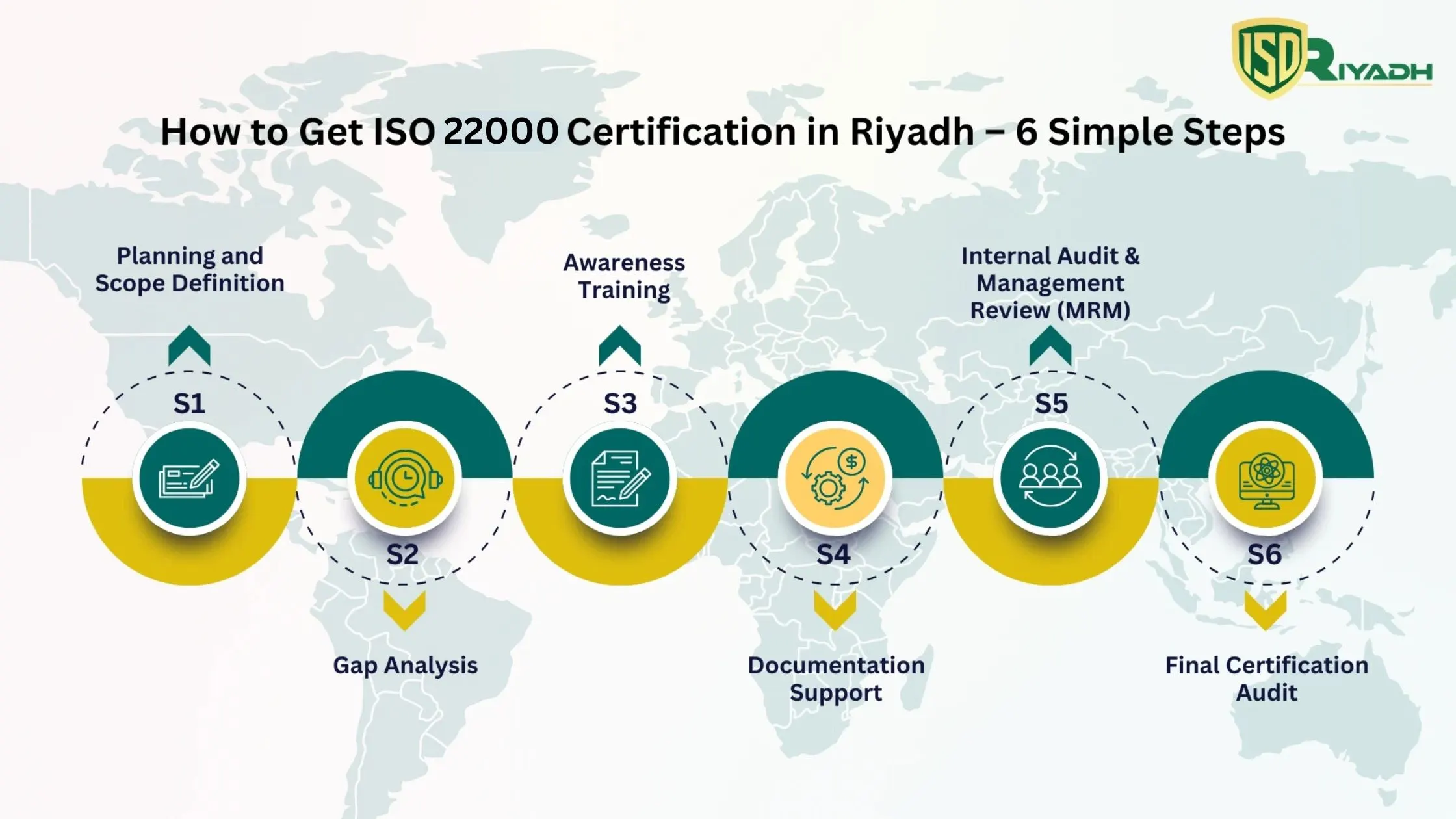
How To Get ISO 22000 Certification Riyadh- 6 Simple Steps
What Are the Benefits of ISO 22000 Certification in Riyadh?
- How Does ISO 22000 Enhance Food Safety and Consumer Protection?
Systematic hazard control ensures safer food. Your FSMS identifies biological hazards (Salmonella), chemical hazards (cleaning residue), and physical hazards (glass fragments) at every stage.
Direct benefits:
- Reduced foodborne illness risks customers stay healthy
- Fewer customer complaints about food quality
- Lower product rejection rates from retailers
- Decreased recall probability protects reputation
- Enhanced brand reputation as safety-conscious business
- Does ISO 22000 Help with SFDA Compliance and Market Access?
SFDA Recognition: Inspectors recognize certified systems. Your organized documentation and monitoring logs demonstrate professionalism that makes inspections straightforward.
Market opportunities:
- Supply major Riyadh hotels (Marriott, Four Seasons, Ritz-Carlton)
- Access supermarket chains with strict requirements
- Qualify for government catering contracts (schools, hospitals)
- Export to international markets
- Partner with multinational food companies
- Can ISO 22000 Reduce Costs and Improve Efficiency?
Process optimization reduces waste and improves operations.
Measurable savings:
- 15-25% reduction in food waste through better inventory control
- Lower spoilage from proper temperature monitoring
- Reduced rework from correct processes first time
- Fewer emergency interventions
- Decreased energy costs
Most certified businesses recover investment within 12-18 months from operational improvements alone.
- Will ISO 22000 Give My Business Competitive Advantage in Riyadh?
Certification differentiates your business in Riyadh’s competitive landscape.
Marketing advantages:
- Display ISO 22000 certificate prominently
- Use “Certified Food Safety Management” in advertising and menus
- Premium positioning customers understand certified businesses invest in safety
- Enhanced trust families seek certified restaurants
- Preferred supplier status
- Social media credibility
How to Achieve ISO 22000 Certification in Riyadh: What Are the 10 Strategic Steps?
Step 1: Management Commitment and Scope Definition
Decision and commitment from business owner is essential. The owner must allocate budget, dedicate staff time, and actively participate.
Define clearly what you’re certifying: Which products? Which locations? Starting with focused scope is smarter than trying to certify everything at once.
Step 2: Assemble Your Food Safety Team
Cross-functional team brings together different perspectives.
Key team members:
- Production or kitchen manager
- Quality control staff
- Purchasing/receiving personnel
- Maintenance representative
- Management representative
Small businesses might combine roles one person can wear multiple hats.
Step 3: Describe Your Products and Processes
Complete description creates foundation for hazard analysis.
Document:
- Raw materials and ingredients (sources, storage requirements)
- Processing steps with detailed flow diagrams
- Packaging materials and methods
- Storage conditions (temperatures, duration)
- Distribution methods (delivery, takeaway, dine-in)
- Intended consumers (general public, children, elderly)
Step 4: Conduct Hazard Analysis (HACCP Principles)
Identify potential hazards systematically at every step.
Three hazard categories:
- Biological: Salmonella, E. coli, Listeria, parasites
- Chemical: Cleaning residue, pesticides, allergens, toxins
- Physical: Glass, metal, plastic, stones
For each hazard, assess risk (likelihood and severity) and determine control measures.
Step 5: Determine Critical Control Points (CCPs)
Identify specific points where control is essential to prevent food safety hazards.
Common CCPs:
- Restaurants: Cooking temperatures (kills pathogens), cold storage (prevents bacterial growth), reheating temperatures
- Food manufacturers: Metal detection, pasteurization temperature/time, pH control
- Bakeries: Baking temperature/time, cooling procedures
Step 6: Establish Critical Limits and Monitoring
Define specific limits at each CCP with clear monitoring.
Examples:
- Cooking: Internal temperature minimum 75°C for 15 seconds
- Cold storage: Temperature at 4°C or below
- Metal detection: Detect particles of 2mm or larger
Monitoring: How often? Who is responsible? How do you record? Continuous temperature loggers work better than manual checks.
Step 7: Implement Prerequisite Programs (PRPs)
Basic conditions creating hygienic environment.
Essential PRPs:
- Facility design and maintenance cleanable walls, floors, ceilings
- Cleaning and sanitization written schedules
- Pest control licensed company contract, monitoring stations
- Employee hygiene handwashing facilities, clean uniforms, no jewelry
- Supplier approval checking licenses, certificates, inspections
- Traceability trace any ingredient batch forward or backward
- Recall procedures what would you do if safety problem discovered
Step 8: Documentation and Training
Create practical documentation actually used.
Key documents:
- Food safety policy signed by owner
- HACCP plan showing hazards, CCPs, limits, monitoring, corrective actions
- Prerequisite program procedures
- Work instructions for critical tasks
- Monitoring and record forms
Training:
- Food safety awareness for ALL staff
- Detailed training for food handlers handwashing, cross-contamination prevention, temperature control
- HACCP training for food safety team
- Internal auditor training
Training isn’t one-time. New employees need training. Annual refresher training required. Document everything.
Step 9: Internal Audit and Management Review
Verify system works before external auditor arrives.
Internal audit checks:
- Are procedures followed in daily practice?
- Are records maintained accurately?
- Are CCPs monitored as specified?
- Are corrective actions taken when problems occur?
- Is everyone trained and competent?
Management review assesses:
- Overall food safety performance incidents? Complaints?
- Internal audit findings problems discovered?
- Achievement of objectives meeting targets?
- Resources needed new equipment, more training?
- Opportunities for improvement
Step 10: Certification Audit
External certification body sends qualified auditors to assess your FSMS.
Two-stage process:
- Stage 1 (Document Review): Auditors review documentation to ensure it meets ISO 22000 requirement soften done remotely. They check if HACCP plan is complete, CCPs properly identified, critical limits appropriate.
- Stage 2 (On-Site Audit): Auditors visit facility for 2-5 days. They walk through operation, interview employees, observe procedures, check records, verify written matches actual practice.
What auditors verify:
- HACCP plan appropriate for your products
- CCPs monitored correctly with accurate records
- Prerequisite programs implemented (pest control, cleaning, hygiene)
- Employees understand food safety responsibilities
- Records complete, accurate, demonstrate effectiveness
- Management genuinely committed and involved
Possible outcomes:
- Pass with no findings (rare but happens)
- Minor non-conformities (corrected within 30 days certificate issued)
- Major non-conformities (significant gaps requiring re-audit rare with proper preparation)
With proper preparation, most businesses pass with only minor findings. The auditor issues your ISO 22000 certificate valid for three years, with annual surveillance audits.
Why Choose POPULARCERT for ISO 22000 in Riyadh?
Riyadh Food Industry Expertise
We understand Riyadh’s unique food sector. From local SFDA and SASO requirements to Vision 2030 alignment, we know what matters for your success. Our consultants provide documentation in Arabic and English, ensuring your team can use the system effectively.
We’ve successfully guided restaurants, catering companies, food manufacturers, bakeries, meat processors, and beverage producers through certification. Whether you operate a small commercial kitchen or manage a large food production facility, we’ve worked with businesses like yours.
Complete Certification Support
From first consultation through ongoing maintenance:
- Free initial consultation and detailed gap analysis
- Complete HACCP study development
- All documentation in your preferred language
- On-site implementation support
- Comprehensive training programs
- Internal audit preparation
- Certification audit coordination
Proven Success in Riyadh
Over 50 Riyadh food businesses certified with 95% first-time success rate. Most clients achieve certification within 4 months. We maintain long-term partnerships, supporting clients through surveillance audits, system updates, and recertification.
Industries in Riyadh Benefiting from ISO Certification
| Industry | ISO Standards Recommended | Key Benefit |
|---|---|---|
| Manufacturing | ISO 9001, ISO 14001, ISO 45001 | Improve production & safety |
| Construction | ISO 9001, ISO 45001 | Win government and infrastructure contracts |
| Oil & Gas | ISO 9001, ISO 14001, ISO 50001 | Enhance safety and sustainability |
| IT & Tech | ISO 9001, ISO 27001 | Improve service reliability and data security |
| Healthcare | ISO 9001, ISO 13485 | Standardize patient care and device management |
| Education | ISO 9001, ISO 21001 | Ensure training quality and consistency |
| Hospitality | ISO 9001, ISO 22000 | Guarantee food and service quality |
Get ISO 22000 Certified in Riyadh Today
Don’t let lack of certification limit your food business growth.
Major clients demand ISO 22000 certification in Riyadh. SFDA expects systematic food safety management. Vision 2030 prioritizes food quality. Your competitors are getting certified and winning contracts.
Every month without certification is a missed opportunity contract you can’t bid on, a retailer you can’t supply, an export market you can’t access.
Contact POPULARCERT.com today and make food safety your competitive advantage.
FAQs
What Is the Investment Range for Riyadh Food Businesses?
Certification investment varies based on:
- Number of employees
- Complexity of operations
- Number of locations
- Current documentation level
- Product variety
Small cafés have different needs than large food plants.
What Does the Certification Cost Include?
Consulting and Implementation:
- Gap analysis
- HACCP study tailored to your products
- Prerequisite programs development
- Employee training programs
- Internal audit preparation
Certification Audit:
- Stage 1 documentation review
- Stage 2 on-site audit
- Certification body fees
Ongoing Maintenance:
- Annual surveillance audits
- System updates
- Training for new employees
- Recertification every 3 years
Will I Get Return on Investment?
Most Riyadh food businesses recover investment within 12-18 months through:
- New contracts requiring certification
- Operational efficiency gains
- Reduced waste and spoilage
- Premium pricing capability (5-10% higher)
- Insurance premium reductions
Real impact: A Riyadh catering company won a major government contract within six months exceeding their certification investment twentyfold. They also reduced food waste by 20%, creating ongoing annual savings.
How does ISO 22000 differ from FSSC 22000 and HACCP?
ISO 22000, FSSC 22000, and HACCP all focus on food safety, but they serve different purposes and levels of assurance.
- HACCP is a food safety method, not a certification standard.
It focuses on identifying and controlling food safety hazards during production. Many companies use HACCP as a foundation, but on its own, it is often not sufficient for international trade or large buyers. - ISO 22000 is an international food safety management system standard.
It includes HACCP principles but adds management system requirements such as documentation, internal audits, supplier control, and continual improvement. It is widely accepted by regulators and customers. - FSSC 22000 is a certification scheme based on ISO 22000 plus additional technical and sector-specific requirements.
It is recognized by the Global Food Safety Initiative (GFSI) and is often required by large retailers, exporters, and multinational buyers.
In simple terms:
HACCP = hazard control method
ISO 22000 = full food safety management system
FSSC 22000 = advanced, globally recognized certification for high-risk or export-focused businesses
What are common challenges Saudi companies face when implementing ISO 22000, and how can they be resolved?
Many Saudi companies struggle with ISO 22000 implementation due to operational and awareness gaps, not because the standard is too complex.
Common challenges include:
- Limited understanding of food safety risk analysis
- Poor or informal documentation practices
- Inadequate employee training and awareness
- Weak supplier control and traceability systems
- Difficulty aligning daily operations with ISO requirements
How these challenges can be resolved:
- Conduct a proper gap analysis before starting implementation
- Use simple, practical documentation aligned with actual operations
- Train staff at all levels on food safety responsibilities
- Establish clear supplier evaluation and monitoring processes
- Integrate ISO 22000 into existing workflows instead of treating it as paperwork
With the right guidance and phased implementation, ISO 22000 becomes manageable and improves overall food safety performance rather than adding complexity.
OUR PRESENCE
Riyadh
Head Office | ISO Consulting & Certification
Jeddah
CE Marking & Product Compliance
Dammam
Oil & Gas | ISO 14001 & ISO 45001
Al Khobar
Information Security | ISO 27001
Mecca
Hospitality | ISO 22000
Medina
Healthcare & Education | ISO 9001