Halal Certification in Riyadh
Halal certification is becoming a key requirement for businesses in Riyadh that serve Muslim consumers or want to sell products in the Saudi market. The word “Halal” means permissible, and in commercial terms it refers to products and processes that comply with Islamic requirements.
Halal certification is not only about meat. It covers packaged foods, snacks, beverages, restaurants, catering, cosmetics, pharmaceuticals, supplements, and even storage and logistics in some cases. For many buyers, halal certification is a trust signal. It proves that your product is made with approved ingredients, handled correctly, and protected from contamination.
Get Free Consultation
Types Of Certifications
- KSA · Riyadh ISO Certification
- Quality ISO 9001 Certification
- Environment ISO 14001 Certification
- OH&S ISO 45001 Certification
- Food ISO 22000 Certification
- InfoSec ISO 27001 Certification
- Medical ISO 13485 Certification
- Lab ISO 17025 Certification
- IT ISO 20000-1 Certification
- EU CE Mark Certification
- Halal Halal Certification حلال
- GMP GMP Certification
What Halal Certification Guarantees
Halal certification guarantees that products comply with Islamic law requirements. It ensures food has been prepared, processed, stored, and delivered following principles in the Quran and Sunnah. For Muslim buyers who stick to halal dietary laws, certification confirms products contain no prohibited substances.
If you are a manufacturer, restaurant owner, importer, or brand in Riyadh, this guide explains the halal certification process, requirements, cost factors, timelines, common mistakes, and how halal consultants help businesses get certified smoothly.
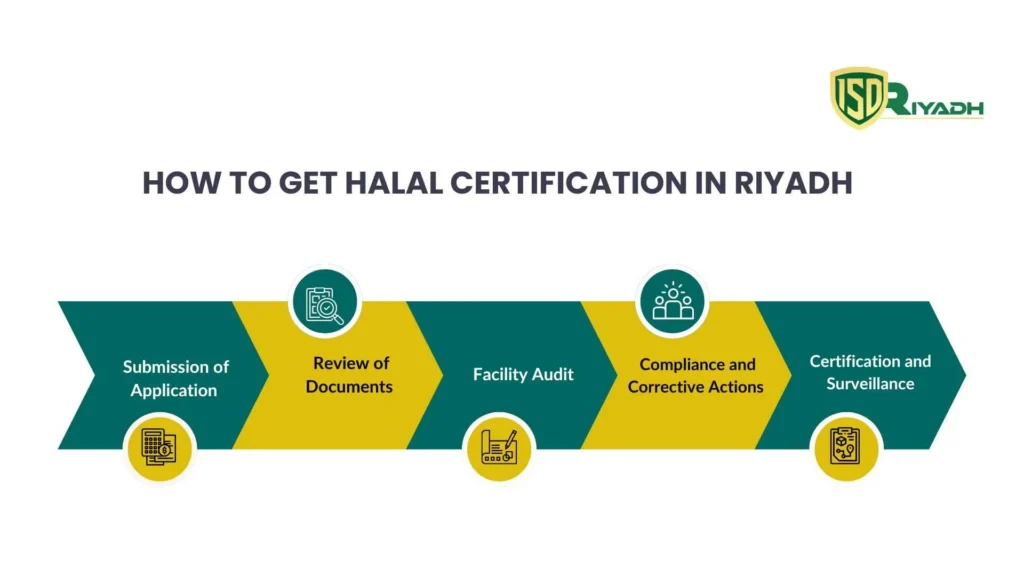
How To Get ISO Halal Certification In Riyadh- 5 Simple Steps
Who Needs Halal Certification in Riyadh?
Understanding whether your business needs halal certification helps you make informed decisions about this valuable credential. In Riyadh’s competitive market, several business types benefit significantly from certification:
- Food Manufacturers and Processors
Any company producing food for Saudi market should obtain certification. Major Riyadh retailers like Panda, Tamimi, and Danube require halal certification from suppliers.
- Restaurants and Food Service
From small shops in Al Batha to fine dining in Kingdom Tower, certification builds trust. Formal certification provides independent verification consumers expect.
- Meat and Poultry Businesses
This sector faces strictest scrutiny. Certification verifies proper Islamic slaughter and supply chain integrity. For meat businesses, certification is essential.
- Cosmetics and Personal Care
Halal cosmetics market is growing rapidly. Products with animal-derived ingredients or alcohol need certification to assure Muslim consumers.
- Pharmaceutical Companies
Medications often contain animal ingredients or alcohol. Certification ensures Muslim patients can use medicines without religious concerns.
- Hotels and Catering Services
Hotels serving food need certification for Muslim guests. Corporate and wedding catering businesses gain competitive advantage through certification.
Real Benefits of Halal Certification for Riyadh Businesses
Halal certification delivers tangible benefits that directly impact your bottom line. These aren’t theoretical advantages these are real results Riyadh businesses experience:
- Customer Trust and Peace of Mind : Halal certification gives Muslim consumers peace of mind knowing products follow Islamic Law. When customers see certification displayed, they feel comfortable purchasing without questioning ingredients.
- Quality Assurance Signal : Certification promises customers that food meets good health and sanitation benchmarks. Many consumers associate halal with higher quality standards.
- Market Expansion Opportunities : For businesses wanting halal certification for the first time, there is an excellent chance to get more customers. The global halal market exceeds $2 trillion annually.
- Competitive Differentiation : Because of that extra independent verification, halal certification can draw in Muslim and non-Muslim customers choosing halal for quality and ethical reasons.
- Retail and Contract Access : Major retailers require certification. Government and corporate contracts often specify halal certification in tender requirements.
- Export Opportunities : Saudi businesses exporting to GCC countries, Malaysia, Indonesia, or Muslim communities worldwide need halal certification for market access.
Halal Certification Cost in Riyadh
There is no single fixed price for halal certification because the cost depends on your business scope. The main cost factors include:
- number of products and SKUs
- number of production lines
- complexity of ingredients
- audit duration
- number of sites (one facility vs multiple branches)
- whether lab testing is required
- whether export recognition is needed
A restaurant with a single kitchen will usually cost much less than a factory with 80 products
Important Warning
Be careful with extremely cheap certificates. Some are not recognized by major buyers or export markets. In that case, you may pay twice: once for the cheap certificate and again for a recognized one.
How to Get Halal Certified in Riyadh: Simple Step-by-Step Process
Getting halal certified is straightforward when you understand the process. Here’s exactly what happens:
- Step 1: Prepare Your Business : Ensure operations are running. Review ingredients, suppliers, and procedures to identify issues before formal assessment.
- Step 2: Choose Certification Body : Select appropriate halal certification authority. Popularcert helps you choose based on your target markets and business type.
- Step 3: Submit Application : Send halal certification request with company name and activity. Include commercial registration, municipal license, facility layout, and product details.
- Step 4: Document Review : After receiving documents and application fee payment, the certification body reviews and assesses your eligibility before facility inspection.
- Step 5: Contract and Audit Fees : For eligible applicants, the certification body sends contract including audit fees to be signed by both parties.
- Step 6: Facility Audit : Audit team visits your facility to assure compliance with halal standards. Auditors inspect production areas, equipment, and documentation.
- Step 7: Corrective Actions : If issues identified, implement corrections with documented evidence. Most issues are minor and easily resolved.
- Step 8: Certificate Issuance : Based upon the certification body's decision committee, halal certificates are issued for approved applicants. Certification valid for one year.
- Step 9: Annual Renewal : Maintain certification through annual surveillance audits. Keep detailed records and notify about significant changes.
Halal + ISO 22000 + HACCP: The Best Setup for Food Businesses
If you want strong market acceptance in 2026, the most effective compliance combination is:
- Halal Certification
- HACCP
- ISO 22000
This combination improves:
- safety
- hygiene
- traceability
- buyer confidence
- export readiness
It also makes audits smoother because your documentation is already structured.
Why Choose Popularcert for Halal Certification?
Deep Halal Expertise : Our team includes Islamic scholars, food technologists, and quality professionals who understand both religious requirements and business needs.
Proven Riyadh Experience : Over 500 Saudi businesses certified across Riyadh’s diverse districts—from Al Batha to Second Industrial City.
Bilingual Support : Consultants speak Arabic and English fluently, ensuring clear communication throughout certification.
Certification Body Relationships : We work with all major halal certification bodies, helping navigate processes efficiently and select the best fit.
Complete Implementation Support : Gap analyses, documentation, training, internal audits, and audit preparation everything covered.
Fast Results : Streamlined process gets businesses certified in 2-4 months without compromising quality.
95% Success Rate : Over 95% of clients pass certification audits first attempt through thorough preparation.
Ongoing Partnership : Support extends beyond certification we help with renewals, compliance, and business growth.
Take Action Now – Free Consultation:
Contact us or send a WhatsApp message. You’ll speak with an experienced consultant who listens to your situation and answers questions honestly. No sales pressure just genuine advice to help you make informed decisions.
Don’t Wait Another Day: The competitive advantages halal certification provides compound over time. Every month you delay is another month of missed opportunities. Call now, send us an email, or visit our Riyadh office. Let’s discuss how halal certification can transform your business.
FAQs
How long does halal certification take?
Most Riyadh businesses complete certification in 3-4 weeks with consultant support. Well-organized operations can achieve faster results.
Can non-Muslims get halal certification?
Yes. Certification focuses on product compliance, not ownership. Many successful certified businesses are non-Muslim owned.
Which certification body should we choose?
Depends on target markets and business type. Popularcert recommends the certification body best serving your objectives.
Is halal certification mandatory?
Not legally mandatory but practically essential for food, cosmetics, and pharma companies due to consumer expectations and retailer requirements.
OUR PRESENCE
Riyadh
Head Office | ISO Consulting & Certification
Jeddah
CE Marking & Product Compliance
Dammam
Oil & Gas | ISO 14001 & ISO 45001
Al Khobar
Information Security | ISO 27001
Mecca
Hospitality | ISO 22000
Medina
Healthcare & Education | ISO 9001